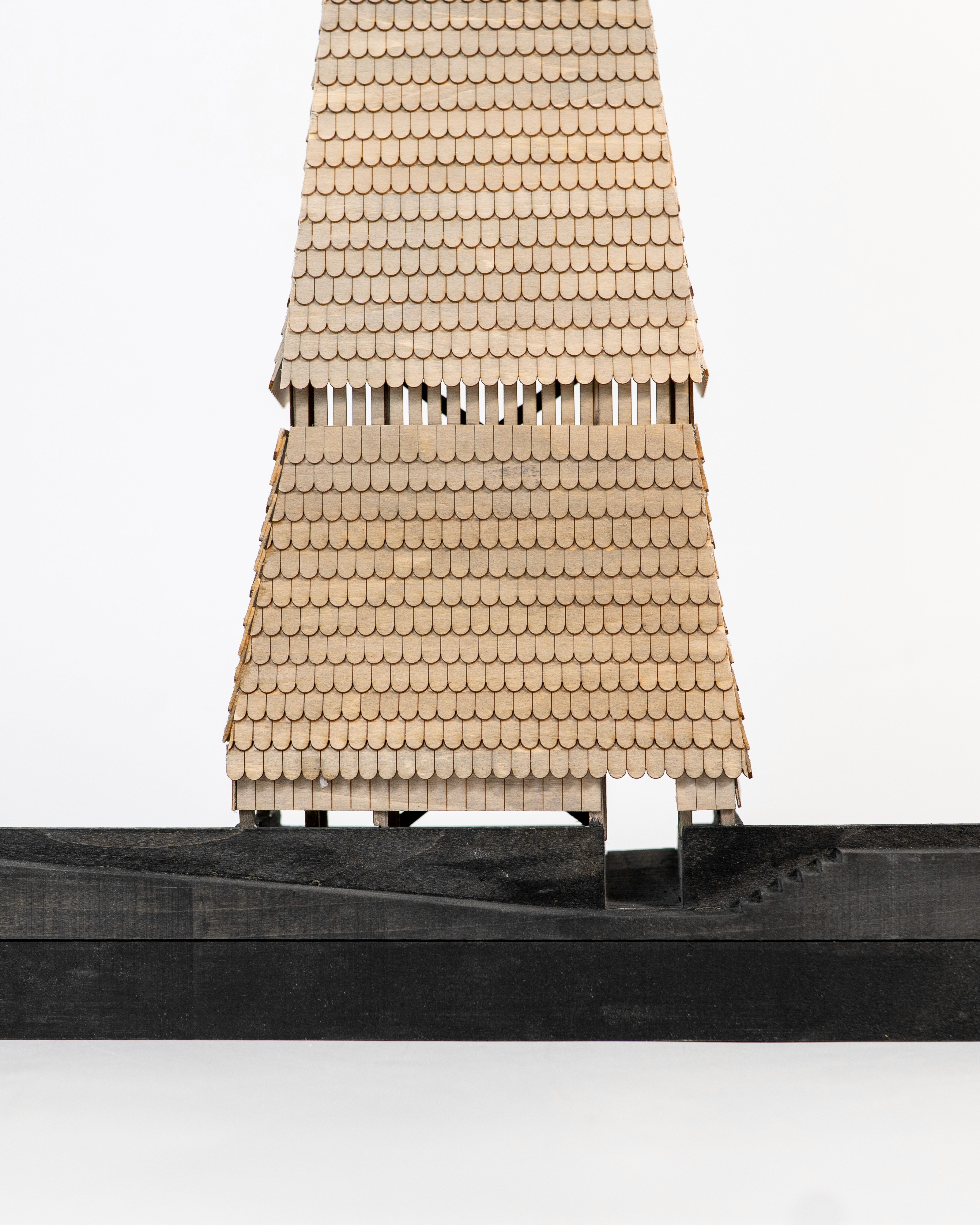
Sugar Tower
The Sugar Tower rises 100 feet above the Vermont forest canopy, its presence announced by a plume of steam visible from the road, the river, and the trail. Sited on a shelf above the flood plain and removed from the main road, the project takes its inherited ground as both a material and temporal argument. The program is drawn from the regional practice of maple sugaring: each spring, sap is tapped from mature trees across the surrounding landscape, collected, and boiled down in a steam-intensive evaporation process. The tower houses this machinery while channeling the resulting steam upward through a stack effect that runs the full height of the structure, turning the building itself into a chimney.
The envelope draws from the shingling logic of Norwegian stave churches, modified so that layers become progressively open from bottom to top: closed against weather at the base, permeable at mid-height for air intake, and fully open at the crown for exhaust. This logic extends into the building's material timeline. Shingles are replaced on a 20-year cycle, secondary structure turns at 50, and the primary heavy timber truss is sized and protected to last a century or more. At the limit of this thinking is a found beam passed between structures across generations, its notches misread as ornament, its origins forgotten, its markings reinterpreted as character. The building banks material for descendants who will not know where it came from.
4.154 Temporal Commons
Spring 2026
Instructors / Brandon Clifford, Timothy Hyde
Photography / Jacob Payne, Andy Ryan